Saturday, September 7, 2013

We're Off!


We had a busy and excellent first day. The time just flew. It was immediately obvious that I have a group of energetic and delightful children!

How We Start Our School Days
Some of you may not know that the 2-3s begin their day with a chance to be physical and social. Last January, a third grader began coming in and asking me for time to blow off steam before she came in the room. Like the Pied Piper, she attracted classmates who began to jog around the gym with her. I heard the need and saw the benefit of this transition time and have embraced it fully ever since. Please read last year’s blog post about this decision--The Benefits of Exercise—if you haven’t seen it.

Arriving at school by 8:40 will ensure that your child receives the benefits of this special time. We are back in the room at 9:00.

Creating A Community
We start our year off with a sustained and deliberate focus on creating a positive and connected community. We talk about our routines, our need to carefully tune in to each other, and the balance of fun and work we’ll have. We practice lining up, try things again when we aren’t meeting the expectations, and think about how we are moving in and using our space. We talk about the need to “think twice and act once” so that we take the best care we can of ourselves and our friends.

Yesterday afternoon, we discussed what it means to take academic risks. I told a story about one of our current 3rd graders that offered a metaphor and language to encourage perseverance and taking academic chances. Last year, this child worked so hard to jump to the third bar on the monkey bars. She couldn’t do it. She was obsessed! She would talk to Darcy and get pointers. She was cheered on by us and other children. But right from the start, she told us she was scared. This child knew that her fear was not allowing her to leap out as far as she needed. One day, enough courage was mustered and she made it!! She’s now an old pro.

Yesterday, we talked about how fear can hold us back from “making it to the third bar.” I told the children that we all needed to be sure that everyone was encouraged to put the fear aside about our abilities and give it a go—that we all had a responsibility to make sure our classroom made that possible. How we talk to ourselves and each other about the work we are doing—being positive and making no negative comparisons—will ensure everyone can take chances.

This was a prelude to a read aloud. I often share the picture book Wings by Christopher Myers. The book’s protagonist, Ikarus Jackson, has wings. The wings make him different—wonderful or weird, depending upon the perspective of the children at his school. Ikarus is mocked and his flying is stilled. That is until a child, who has also faced criticism from her peers, shouts out how beautiful Ikarus is. He then is able to fly again. We had a wonderful conversation about why the book might have been written and what lessons it teaches us. Don’t criticize. Encourage. Make sure everyone can jump to the third bar.  

And, we’re off!!!

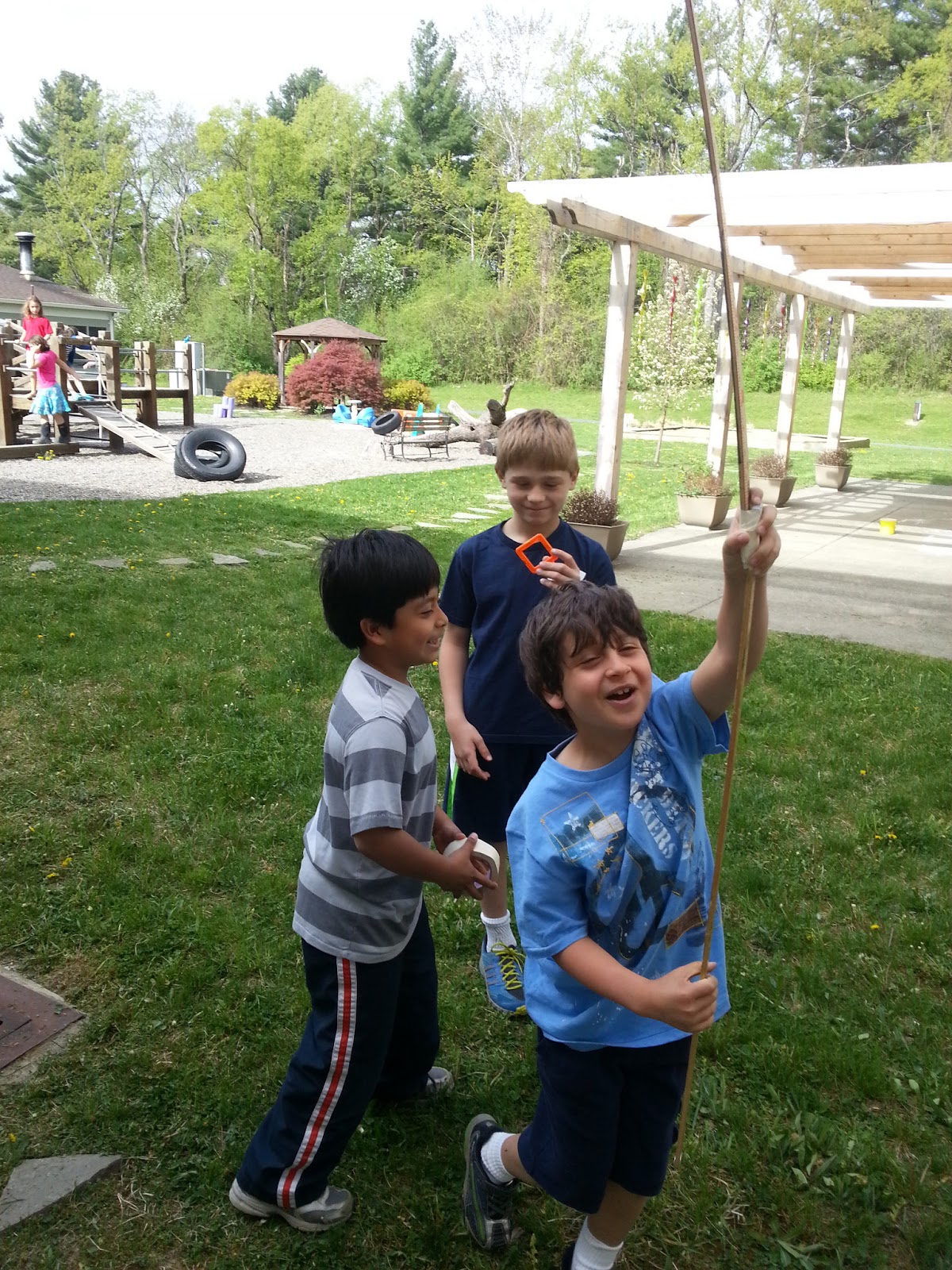
Here are the children meeting in pairs or trios to brainstorm what the 2-3s might present at Assembly.


Friday, May 10, 2013

Busy Weeks

 STEM

Last week while the 8th grade went to Philadelphia for their class trip, the 6-7s had STEM week. This is a special feature of life in the middle school as the group is challenged to work on a week-long project that highlights Science, Technology, Engineering and Math. Traditionally, the projects rotate from rocketry to bridge building on a two year cycle. This was a bridge year and the group was challenged to work in teams to design and build sections of bridge to go over one of our creeks. Rich and exciting work for our younger students to look forward to in their years ahead at Parker.


We joined in with a whole school kick-off for STEM week that Monday morning. Shelli Failing (5th-8th grade math) and Kate Perry (K-8 science) mixed the K-7s into groups to design and build with only two materials: straws and paper clips. The challenge: build the tallest and sturdiest structure they could. Every structure was unique to that group. We saw communication skills, teamwork and innovation in action!


Friday afternoon, the whole school went out to the woods to watch the final placement of the 6-7s' bridge sections and then to have a ceremonial walk over our new path!


Saying Goodbye
Our Hudson Valley Community College student teacher, Sarah, had her last day with us on Wednesday. The children had grown fond of her and had enjoyed the lessons she led them through. The group sat together for a final picture.


Wildlife in China
One of our 3rd graders invited his Uncle Dan to come to the classroom and share his knowledge of wildlife in China. Dan just recently retired from the Adirondack Park Agency. That career took him to China to provide training on wildlife conservation and public education to his counterparts in that country.

We learned about animals China has in common with the U.S. (elk, cranes, bats, etc.) as well as creatures that are special to the country (Great Panda, red panda, Prezewalski's horse and many others). As Dan presented his slides, he was met with those oohs and aaahs this group always brings to images of animals. Later that day, the children finalized their topics for their China essays. I had challenged the children to top their work in the fall...Dan's visit provided fabulous inspiration.

By the end of the day, every child's list of topics had grown to include, on average, two to three animals. You go, kids!!! We are now knee-deep in essay writing.

Uncle Dan on one of his trips to China (far right)

Guam
Another 3rd grader expanded our knowledge this week. This past winter, she had a wonderful family trip to Guam. She had been given a school assignment while she was gone: collect information and impressions from her trip to teach us about when she returned. This week, she presented her learning and shared many first-hand experiences she had while in this island country. We found out about Guam's wildlife and history, and saw photos and videos that tracked the adventures they enjoyed as a family in, on and near the stunning Pacific.More oohs and aaahs from the 2-3s!

The Great Outdoors
We continue to open our mornings with physical activity and also make sure to take breaks throughout the day to breathe in the fresh air. Time in the woods opens the mind and prepares us for the work we do in our busy days.


Monday, April 22, 2013

Spring is Here: Time for a Tune-Up

We all wait anxiously for spring (ahem, when will it feel like it has really arrived?). After months of being cooped up, the children are anxious to run around. Spirits are high.


In the classroom, we have hit our stride. The children are comfortable with each other, friendships have formed, strengthened, maybe shifted. They “get” me and my expectations. We can talk in shorthand as we work together on projects, share insights about books, and have meals together. We share comic bits and inside jokes.  
 
By spring, the group has become a family, with strong connections and a level of comfort that helps us run like a machine. This level of comfort can also mean that the children break off into little networks that pull them away from the larger group—social preferences are acted on. This is the time of year that I revisit discussions about exclusion in our work and play.

In eight years of teaching 2-3s at Parker, I have noticed a pattern in the classroom’s social life: spring means it’s time to tune up our interactions. Right now, I am working with the children to to reconnect as a whole group, stretch social wings, and reassert our responsibilities to each other. So how do we do this?


First, I raised the issue of social exclusion in a class meeting. I talked about how all human beings like to belong, like to be in groups they find comfortable. These groups we form often mean that we've left others out. I saw lots of nodding heads. I stressed that they'll work their whole lives to balance out their strong connections with some friends while also staying open to others. I presented some typical examples of exclusion that I have witnessed over the years. We discussed these examples as a class. We discussed why good people sometimes make decisions that keep others out. I asked the children to raise their hands if they’ve ever felt excluded. Each one of us raised our hands.
 
We then played a game I picked up from Scholastic’s website:
 
The Tight Hands Game. This game gives children a metaphor for discussing inclusion and exclusion. The group held hands in a circle. One volunteer, the “outsider,” was instructed to try to get into the circle through spaces between people. Our outsider knew that everyone else would try to keep her out,  but everyone committed to being gentle when blocking. They all were.
 
After playing a bit, I asked:
    * What did it feel like to be an outsider?
* What did it feel like to block our friend from getting in?

No one felt comfortable with his/her actions in this game which led to an excellent exchange about personal experiences feeling on the outside. Others hypothesized about why people make decisions to exclude. We all agreed that every individual had a responsibility to stop acts of exclusion, remind our friends to stay open to others, and to take chances ourselves and play with other friends.
 
Over the next several weeks, the children will be asked to sit at their home bases for lunch a few times a week, and to make efforts to connect/reconnect with other friends in the room besides their typical circles. 

As I continue to raise our commitment to inclusion, the children sometimes tell me these discussions bring up guilty feelings. I assure them that they are only human and are allowed to make social moves they regret later. What's important is that they learn each time. This discomfort is okay. This is a sign we need to keep the topic alive. This is really hard work.

I strive to have lots of give-and-take and idea-sharing in our conversations, as opposed to me lecturing. When children share their experiences and emotions, they are helping to develop empathy in others and soften those tight circles.  
 
These whole class discussions have also spurred some private small group conversations to iron out hard feelings about exclusion. In addition, Darcy is also following up in Health class and P.E., hosting conversations and games to promote whole group ties. It’s been a fruitful couple of weeks.
 
I know how important this issue is to all of you. Here are some ideas, if you need them, to help you reinforce what we’re up to at school: 
  • Gently remind your child that you expect him/her to be inclusive…to look up and out from his/her typical circle, and to proactively engage many peers in their play.
  • Give examples of how you included others in your games as you were growing up.
  • Rehearse how to remind a friend to include others—confronting a friend is high stakes, but peer-to-peer encouragement is hugely powerful. 
  • Have your child set up a plan to spark or refresh a connection with a peer. Follow up, reinforce and encourage more of this with other peers.
  • Create opportunities – play dates—for your child to spend time with classmates that would expand her/his social circle.

This is a powerful and dynamic group. Remember, this group has an ease with each other that is remarkable. This social work is all about making them even stronger.


Sunday, March 24, 2013

The Benefits of Exercise


Sometime in January, one of our 3rd graders began greeting me each morning, asking if she could run some laps in the gym. She seemed anxious to channel her pent-up energy and prepare for her school day. Aaaah, winter.

I had my regular routine for Morning Work in place (often Language Arts activities) and felt I could delay the start of that work for a few minutes. “Go ahead!” I’d say. Quickly, this became a daily request and her classmates were also moving in to the gym as they arrived. I’d watch from the gym stage, getting my paperwork ready, and see the shining faces of my students as they chased each other or just ran laps. It became apparent to me that something really important was happening. My students needed something to kick off their day that I wasn’t providing.

Darcy DeMaria, our P.E. & Health teacher, has talked to me over the years about the research that has shown how exercise improves school performance. That made perfect sense to me. My colleagues and I celebrate our cherished two-a-day recesses in the lower school. I have always worked movement and brain breaks in to our school days, especially when I see fatigue or lack of focus set in. But starting our school day with full-fledged exercise was something the children had to lead me to embrace.

Recent studies have employed M.R.I.s to look closely at exercise's relationship to brain development and cognitive performance. A New York Times blog item featured the results of a study from the University of Illinois: 
http://well.blogs.nytimes.com/2010/09/15/phys-ed-can-exercise-make-kids-smarter/ 

Since mid-winter, we have kicked off our school days in the gym. We're usually in there a bit after 8:30 and spend at least 20-30 minutes running around. The children move from free play into something organized like tag games or Pop Up Penguins when enough children have arrived to make those activities viable. Middle schoolers typically arrive in the gym before we leave and join us for a few minutes. 

Last week, the gym was occupied on several days by special activities for the middle schoolers and our visitors from Spain. So we went outside to enjoy the freshly fallen snow (Happy Spring!) and some sledding. Once spring has settled in, we should open our days outside whenever we can. 


I see a huge social benefit from these active gatherings. I also see elevated moods and energy that the children carry into their school day. And, my teacher self knows that we still have time for snack and some focused D.E.A.R. or writing. A win-win.
Winding down with our middle school friends


Monday, February 4, 2013

AMONG READERS & POETS

Literature Circles
Our Literature Circles have been up and running.

One group concluded Judy Blume's Freckle Juice last week, a piece of realistic fiction about a boy who wants freckles. Why? So he won't have to bathe as frequently. That group will launch a new book before the week's end.  


A second group is nearing the end of Cynthia Rylant's Gooseberry Park, a tender story of the relationship between a protective Labrador retriever named Kona and a squirrel named Stumpy who has just had babies. Add in Murray, a bat who can't fly straight, and you've got a sweet story about friends acting like family.

The last group is up to their elbows (or eyeballs) in Avi's Poppy, which traces the daring quest of a timid mouse searching for a safer home for her extended family. She has to face her own fears as well as the villainy of a resident great horned owl to help the family.


All three books lend themselves to discussions about family, the choices people (or dogs, squirrels, bats or mice) make to improve their lives, and how authors present life lessons through characters.  

Poetry Writing

The group has also been drafting winter poems, inspired by the season. The children first read three published poems to serve as inspiration: John Updike's January, Douglas Florian's Winter Eyes, and Katherine Mansfield's Winter Song. The kids read the poems to themselves and then chose favorite lines/stanzas to read out loud to us. We looked more closely at each poem and talked about poetic choices the authors made, pointed out descriptive language and untangled what the poets might mean with some more abstract lines. The children then did choral readings of each poem in duos and trios.


Here's John Updike's poem:

 January

The days are short,
The sun a spark
Hung thin between
The dark and dark.

Fat snowy footsteps
Track the floor,
And parkas pile up
Near the door.

The river is
A frozen place
Held still beneath
The trees' black lace.

The sky is low.
The wind is gray.
The radiator
Purrs all day.

The group then brainstormed words and phrases about winter. Those ideas were collected on chart paper for all to see and work from, if they chose to. Drafting began, with a template offered by me to help structure the poems. Poets had the choice to write independently and without the template if they felt inspired on their own. The drafting went on for several days and the focus increased each day. The poets have almost all typed up their first drafts. We are now ready for critique. Today, four poets shared and got compliments and suggestions about their pieces via our "Compliment Sandwich" critique procedure. We'll continue tomorrow. Revisions and publishing will follow. I am excited for them to share their beautiful words.